18 August 2026
The Healing Tree Collective • Empathy, Compassion and Community
Come As You Are: How Community Builds Empathy, Compassion and Connection
Coming as you are means you do not have to hide where you are emotionally before entering a shared space.
You may arrive carrying grief. You may be celebrating a milestone, questioning a relationship, feeling uncertain about work, or trying to understand a season of life that does not yet make sense. You may feel calm, overwhelmed, hopeful, frustrated, exhausted, or unable to put your experience into words.
Community does not require everyone to arrive in the same emotional state. It gives us an opportunity to recognize that every person is walking through a different part of life, often carrying stories and responsibilities we cannot see from the outside.
At The Healing Tree Collective, “come as you are” is not only a welcoming phrase. It reflects the kind of community we hope to create: one where people do not have to perform happiness, calmness, spirituality, certainty, or emotional strength in order to belong.
When people are allowed to be honest about where they are, the room becomes an opportunity to practice empathy. We begin learning how to acknowledge another person’s experience without comparing it with our own, trying to change it, or assuming that their emotions are about us.
Coming as you are may mean:
- You do not have to pretend to feel better than you do
- You can celebrate without minimizing someone else’s struggle
- You may participate quietly without explaining yourself
- You can acknowledge another person without absorbing their emotions
- You are welcome even when you do not have the right words yet
What does it really mean to come as you are?
“Come as you are” can sound simple, but many of us have learned to enter spaces by first deciding which parts of ourselves are acceptable to show.
We may believe that we should appear calm in a wellness class, positive around friends, confident at work, or emotionally composed when other people are depending on us. Even when we are struggling, we may feel pressure to say that everything is fine because we do not want to make anyone uncomfortable.
Coming as you are does not mean sharing every personal detail or expressing every emotion publicly. It means you do not have to deny your actual experience in order to participate.
You can enter a room knowing that you feel sad without being required to explain why. You can recognize that your mind is busy without pretending that meditation immediately made you peaceful. You can be joyful without apologizing for that joy because someone else is moving through a difficult season.
The invitation is not complete emotional exposure. It is honesty without performance.
Coming as you are means you do not have to become a more acceptable version of yourself before you are allowed to belong.
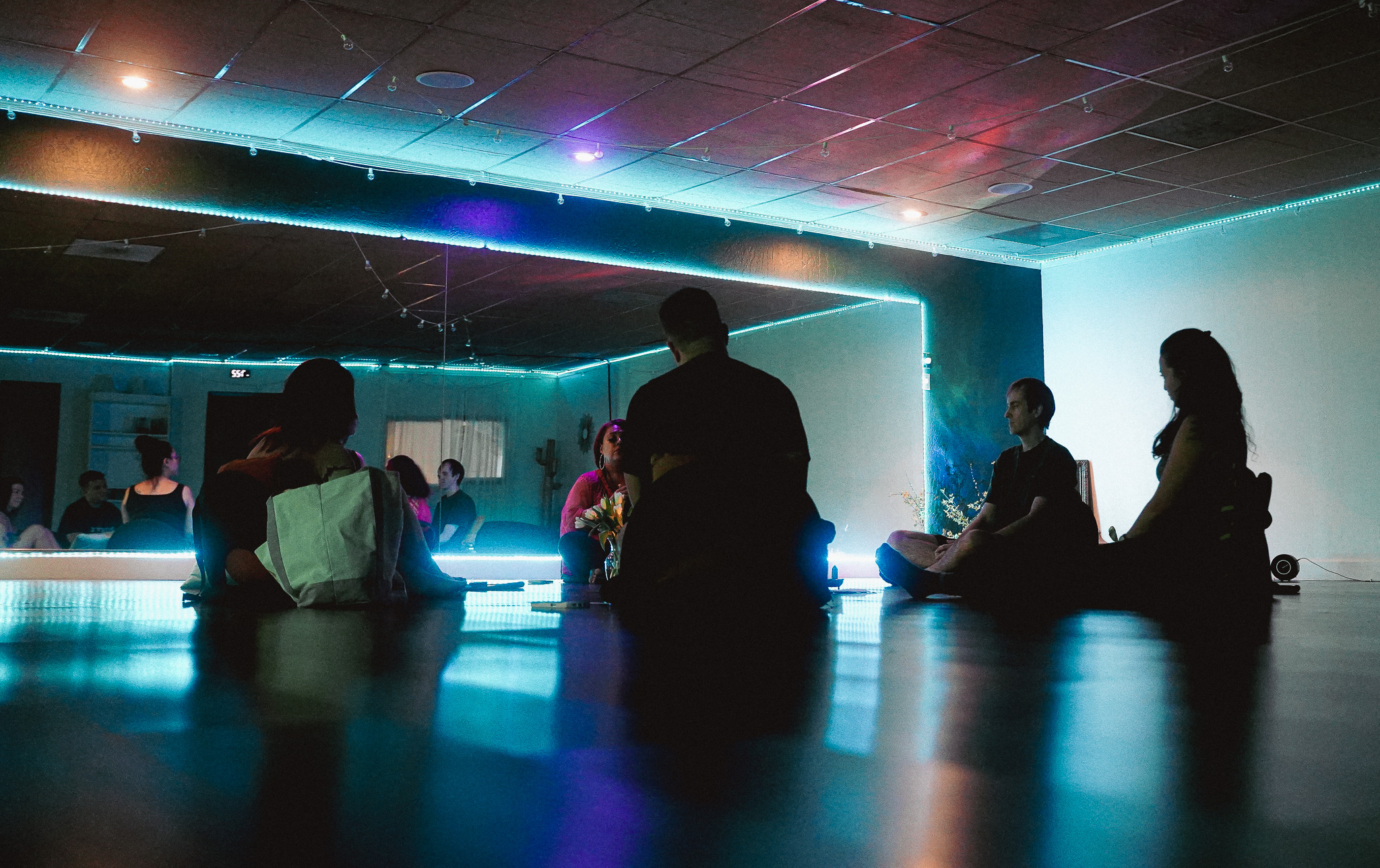

Every person enters the room carrying a different story
Two people may be sitting beside each other while experiencing completely different seasons of life. One may be grieving a loss that no one in the room knows about. Another may have just received an opportunity they have hoped for over many years.
Someone may be questioning whether to leave a job, begin a business, end a relationship, or take a new direction. Another person may feel generally content but recognize that they have not slowed down in a long time.
We cannot always see these stories from the outside. A person who appears withdrawn may be exhausted. Someone who seems impatient may be managing a responsibility that has stretched their capacity. A person who speaks very little may be listening carefully rather than disengaging.
Community gives us a chance to remember that what we see is only one moment within a much larger life.
Every person you meet is carrying a story that cannot be fully understood through one interaction.
People may enter the same space while carrying:
Grief or uncertainty
Someone may be mourning a person, relationship, identity, opportunity, or version of life they expected to have.
Joy or celebration
Another person may be celebrating a milestone, new relationship, career change, personal accomplishment, or meaningful beginning.
Something unnamed
A person may know that something feels different without having language for the emotion, need, or transition yet.
Community teaches us how to hold different experiences at the same time
One of the gifts of community is learning that several emotional realities can exist in the same room without canceling one another out.
Someone can be grieving while another person is celebrating. One person can feel hopeful while someone else feels uncertain. A participant may feel deeply connected during a practice while the person beside them struggles to settle.
We do not have to decide which experience is more valid. Community can hold complexity.
This teaches us that compassion does not require us to abandon our own emotional state. We can make room for another person’s pain without believing we must become equally sad. We can celebrate another person’s success without comparing it with what has not happened in our own lives.
We can say, “This is where you are,” while also acknowledging, “This is where I am.”
Empathy does not ask us to erase our own experience. It asks us to recognize that another person’s experience can also be true.
Compassion without boundaries may feel like:
Believing you must absorb another person’s emotions, solve their problem, abandon your own joy, or make yourself responsible for their entire experience.
Compassion with boundaries may feel like:
Acknowledging what someone is carrying, listening with care, and remaining connected to your own feelings, limits, and responsibilities.
You can care about someone without losing yourself
Empathy is sometimes confused with emotional absorption. We may believe that caring requires us to feel everything another person feels or immediately take responsibility for helping them feel better.
That can become overwhelming, especially for people who are highly sensitive to the moods and needs of those around them. They may enter a room and begin monitoring everyone else before checking in with themselves.
Compassion can be more grounded than that. It allows us to notice another person’s emotional state without automatically making it our own.
You may recognize that someone is upset and still know that their reaction is not necessarily about you. You may listen to a difficult story without believing that you must provide an answer. You may offer care while also acknowledging that you do not have the capacity to take on more responsibility.
Boundaries do not make compassion less real. They help make it sustainable.
Grounded compassion may sound like:
- “I can acknowledge what you are feeling without assuming I caused it.”
- “I care about you, and I may not have the right answer.”
- “I can listen without taking responsibility for fixing everything.”
- “Your joy does not take anything away from me.”
- “Your difficult season does not require me to deny what is good in my life.”
- “I can remain connected to myself while being present with you.”

Empathy does not require excusing harmful behavior
Remembering that someone has a larger story does not mean accepting behavior that causes harm. Compassion and accountability can exist together.
We can recognize that a person may be stressed, grieving, frightened, or overwhelmed while still setting a boundary around how they speak to us or treat others. Understanding where behavior may come from does not automatically make the behavior appropriate.
Empathy helps us respond with greater awareness rather than reducing someone to their worst moment. Boundaries help us protect dignity, safety, and respect within the relationship.
This distinction matters because community should not ask people to tolerate harm in the name of compassion. A healthy space makes room for humanity while also recognizing responsibility.
Compassion helps us remember the person behind the behavior. Boundaries help us remain honest about the impact of that behavior.
Practicing compassion beyond the wellness space
What we practice in community can influence how we respond to people throughout everyday life.
Someone may be impatient in traffic, withdrawn at work, unusually emotional during a conversation, or less responsive than usual. Our first reaction may be to take the behavior personally or decide what it says about their character.
Empathy invites us to leave room for what we do not know. Perhaps they received difficult news, slept very little, are supporting someone through a crisis, or feel overwhelmed by circumstances that are not visible to us.
This does not mean inventing explanations for every behavior or overlooking what affects us. It means pausing before assuming that one moment tells us everything about a person.
That pause may change the tone of a conversation. It may help us ask a better question, respond less defensively, or recognize that another person’s emotional state is not always a judgment of us.
Empathy in everyday life may look like:
- Pausing before assuming someone’s behavior is personal
- Asking a thoughtful question rather than making an immediate judgment
- Recognizing when someone may need space
- Listening before offering advice
- Celebrating another person without comparing timelines
- Maintaining a boundary without dehumanizing the other person
- Remembering that one interaction does not reveal an entire life
Being witnessed does not require being fixed
Many people are accustomed to conversations where vulnerability is quickly followed by advice. Someone shares that they are struggling, and the listener immediately begins searching for the solution.
Advice can sometimes be useful, especially when it is requested. At other times, the most supportive response is simply allowing someone to say what is true.
Being witnessed means a person’s experience can be acknowledged without being corrected, compared, or rushed toward a more comfortable emotional state. They may not know what they need yet. They may be speaking because they need language, connection, or the relief of no longer carrying the thought alone.
A compassionate community recognizes that not every emotion is a problem requiring immediate resolution.
Sometimes people do not need us to change where they are. They need to know they do not have to hide there.
Come as you are also means you can participate quietly
Not everyone processes through speaking. Some people need time before they know what they feel, and others may prefer to keep their experience private.
A welcoming community does not make belonging dependent on disclosure. You can come as you are and choose to listen. You can rest, move, breathe, reflect, or simply observe what is happening within you.
Silence is not always disengagement. It may be a form of processing, self-protection, discernment, or presence.
The freedom not to share can make it safer to participate. When people know that they will not be pressured to explain themselves, they may become more able to listen honestly to what they need.
You do not have to tell your entire story to be welcomed into the room.

Community can expand the way we understand other people
When we spend time only with people whose lives resemble our own, it can become easy to assume that our experience is the standard. Intentional community brings us into contact with people who may be navigating life through different cultures, generations, identities, professions, family structures, and responsibilities.
We may hear a perspective we had not considered or recognize the impact of an experience we have never personally lived. That does not mean we will understand everything immediately or agree on every subject.
It means we have another opportunity to listen beyond our assumptions.
Empathy grows when we become more willing to acknowledge that another person’s reality may be different from ours and still deserve care, respect, and attention.
Community helps turn abstract ideas about compassion into lived practice. We are no longer only thinking about humanity in general. We are sitting beside an actual person whose story may challenge, deepen, or expand our understanding.
A beginner-friendly wellness community in Tempe, Arizona
The Healing Tree Collective is a community wellness studio in Tempe, Arizona, offering accessible, beginner-friendly spaces for reflection, nervous system care, creativity, connection, and personal growth.
Our intention is to create experiences where people can explore supportive wellness practices while remaining connected to their own bodies, boundaries, emotions, and choices. You do not need to arrive calm, know anyone in the room, or understand every modality before attending.
Explore wellness and community at The Healing Tree Collective
Our Tempe wellness community welcomes guests from Tempe, Phoenix, Mesa, Chandler, Scottsdale, the ASU community, and throughout the East Valley.
You can arrive in joy, grief, uncertainty, exhaustion, curiosity, or transition. You can speak, listen, rest, or simply take time to be present.
You do not have to hide where you are
There is relief in entering a space where you do not have to create a more acceptable version of your life before participating.
You do not need to hide your grief because someone else is celebrating. You do not need to minimize your joy because another person is struggling. You do not need to absorb the emotions around you in order to prove that you care.
You can acknowledge the person beside you while remaining connected to yourself.
This is one of the ways community builds empathy. It teaches us that different experiences can exist beside one another. It reminds us that every person is carrying more than we can see. It gives us practice listening without immediately judging, fixing, comparing, or leaving ourselves behind.
Come as you are does not mean every behavior is accepted or every boundary disappears. It means your humanity is not reduced to how calm, positive, successful, or emotionally composed you appear in one moment.
Come as you are and remain connected to who you are
At The Healing Tree Collective, we create community wellness experiences where people can slow down, listen inward, and practice being with others without pressure to perform a particular emotional state.
Join us at our Tempe wellness studio and explore a class rooted in reflection, compassion, nervous system care, and meaningful human connection. You do not have to hide where you are before entering the room.