15 September 2026
The Healing Tree Collective • Imagination, Community and Collective Intention
It Takes a Little Delusion to Create Something That Doesn’t Exist Yet
I sometimes joke that it takes being a little delusional to create something that does not exist yet.
I do not mean being disconnected from reality. I do not mean ignoring evidence, pretending problems are not real, or convincing ourselves that wanting something badly enough automatically makes it happen. What I mean is that there are moments in creation when the thing you believe in exists more clearly in your imagination than it does anywhere in the physical world around you, and you still have to decide whether you are willing to move toward it.
The Healing Tree Collective was once like that for us. What exists today.. the people walking through the doors, practitioners leading classes, members becoming familiar faces, strangers becoming community, people trying practices they had never experienced before was once something we could only imagine. There was a point when the reality around us did not yet contain the evidence of what we believed could exist.
We had an idea. We had an intention. We had a feeling about what the space could become. Then we had to make decisions, take risks, learn, adjust, fail at things, try again, and keep building long enough for some portion of that imagined future to become visible.
So when I think about Global Heart Activation and this idea of people gathering in collective prayer and meditation, I find myself returning to that same relationship with possibility.
I do not know everything that collective prayer can influence. I do not know whether consciousness works in all the ways people have theorized. I do not know whether gathering in a room around peace can somehow influence people we never meet.
But I also do not think uncertainty requires us to stop imagining.
The question underneath this idea
What possibilities do we never explore because they initially sound too idealistic, too ambitious, too strange, or too far outside what currently exists?
There is wisdom in questioning an idea before believing it. But there is also something worth examining about what happens when skepticism becomes so strong that imagination itself begins to feel embarrassing.
Almost everything we intentionally create begins with a gap between reality and imagination
There is an uncomfortable stage in almost every creative process where the vision is significantly larger than the evidence.
An entrepreneur sees a business before there are customers. An artist sees a finished piece before anything exists on the canvas. Someone imagining a healthier relationship can see the kind of communication they want before either person has learned how to communicate that way consistently. A community organizer may believe a neighborhood can become more connected while standing inside the reality of how disconnected it currently feels.
None of those visions deserve automatic belief simply because someone imagined them. Some ideas do not work. Some need to change dramatically. Some collide with constraints we did not understand when we started. Some were based on assumptions that turn out to be wrong.
But creation requires enough belief to begin anyway.
That is the kind of “delusion” I am talking about. There has to be some willingness to act in the direction of something before the present moment can fully prove that the future you imagine will work.
Otherwise, we could only create things that already exist.
Creation asks us to respect reality without allowing the present version of reality to become the only future we are capable of imagining.
I think that distinction becomes especially important when the thing we are imagining is not a product or a business, but a different kind of community.
Can people become less divided? Can workplaces become more human? Can families interrupt patterns that have been passed down for generations? Can strangers learn to sit beside one another with greater curiosity? Can a room full of people intentionally practice peace and then carry something from that practice into their lives?
None of those possibilities should be treated as guaranteed.
But why should the absence of a guarantee stop us from participating in them?
There is a difference between being visionary and being disconnected from reality
This is where I think the word “delusional” needs some unpacking, because the way we use it conversationally here is playful. We are talking about having the courage to believe in an idea before everyone around us can see it. We are not talking about ignoring reality.
Healthy vision still has to listen.
If we build a class and nobody connects with it, we should pay attention. If our business model does not financially work, belief alone will not pay the bills. If something we thought would serve people is actually causing harm, integrity requires us to reconsider it. If evidence challenges a factual claim we are making, the responsible response is not to protect the dream by ignoring the evidence.
Vision becomes useful when it remains in conversation with reality.
The dream says, “I think something different is possible.”
Reality says, “Here is what is actually happening.”
Then the work is figuring out how to keep adjusting the path without losing the deeper reason you started walking it.
A vision does not become more powerful because we refuse to question it. The strongest visions are often the ones that can survive contact with reality, evolve, and still remember what they were trying to create.
Is the dream asking you to ignore reality.. or asking you to participate in changing it?
Those are very different things. One protects an idea from evidence. The other accepts the evidence of the present and asks whether our choices might contribute to a different future.
Maybe the most useful question is not simply, “Do I believe this?” It may be, “What would responsible participation in this possibility actually look like?” That question requires imagination and accountability at the same time.
The Maharishi Effect gave language to a possibility we were already interested in
Part of what inspired this conversation was learning about the Maharishi Effect, a theory associated with Transcendental Meditation that proposes that contemplative practice may have effects extending beyond the individual practitioners themselves.
One version of the theory proposes that when approximately one percent of a population practices Transcendental Meditation, improvements may appear in broader social conditions. Later versions associated with advanced group practice proposed a different threshold and mechanism.
Claims connected with the theory have included lower crime, less violence, greater social coherence, and other changes in collective behavior.
Those are extraordinary claims, and we should treat them accordingly. Global Heart Activation is not Transcendental Meditation, it is not the TM-Sidhi program, and we are not conducting a scientific recreation of those studies at The Healing Tree.
So when I say that the Maharishi Effect inspired this idea, I do not mean that we can borrow its name and assume the same effect applies to anything involving group meditation.
What interested us was the underlying question:
Could what we practice together have consequences larger than the individual experience of the practice?
That question fits almost perfectly with something we already talk about constantly at The Healing Tree: the ripple.
The theory did not give us permission to claim an outcome. It gave us another way to ask a question we were already asking: how far can what happens within us travel through the world around us?
We already see one kind of ripple every day
Before we ever try to answer the larger consciousness question, there is a much more immediate form of influence that is easier to understand.
We affect one another.
Not mystically. Relationally.
If I walk into my home stressed, exhausted, reactive, and impatient, the people around me experience some version of that state through my behavior. If I learn to recognize my overwhelm sooner and communicate differently, they experience that difference too.
If a leader does their own inner work around control, defensiveness, and fear, the people on their team may experience a different kind of leadership. If a parent begins questioning an inherited belief about emotion, the children in that home may grow up inside a different emotional culture. If someone becomes more willing to listen across disagreement, the conversations they participate in begin changing.
One person changes something within themselves, then that change enters a relationship.
Relationships create families, workplaces, organizations, neighborhoods, and communities.
That is already collective influence.
It is not as dramatic as saying consciousness itself has shifted an energetic field around a city. But it may actually give us a practical foundation for understanding why collective inner work matters regardless of what we ultimately conclude about the larger theory.
We do not need an extraordinary explanation for every ripple. Some ripples move through the very ordinary reality that changed people participate differently in shared life.
A ripple can move through many layers
Within us
We notice our thoughts, reactions, assumptions, emotions, and patterns with greater awareness.
Between us
Awareness may begin influencing communication, boundaries, conflict, care, leadership, and the way we treat other people.
Around us
Relationships collectively shape the cultures inside families, workplaces, organizations, and communities.
Beyond what we know
Some people also hold spiritual beliefs about prayer, consciousness, and collective intention that extend beyond these observable pathways.
What if the “energetic field” is something we can hold spiritually without pretending we have measured it?
In the video, I talk about consciousness, energy, and the energetic field around us. Those words are meaningful within many spiritual and wellness traditions, but they can easily become confusing when we begin speaking about them as though everyone means the same thing.
Some people understand energy spiritually. They believe human consciousness, prayer, or intention participates in a larger energetic reality. Someone else may hear “energy of the room” and understand it socially: tone of voice, facial expression, body language, tension, emotional contagion, trust, familiarity, and the subtle ways people respond to one another.
Those are different explanations.
We do not have to force them into one category.
If someone experiences Global Heart Activation through a spiritual framework and believes collective prayer influences an energetic field, there is room for that belief.
If someone else approaches the same gathering more cautiously and says, “I do not know about an energetic field, but I do believe people intentionally practicing compassion together can influence how they treat one another,” there is room for that too.
What matters to me is that we remain clear about when we are speaking from belief and when we are speaking about something we can observe directly.
Spiritual openness becomes more credible, not less, when we are willing to say which parts are belief, which parts are experience, and which parts remain unanswered questions.
Do we lose anything by saying “I don’t know”?
Sometimes spiritual communities can feel pressure to explain every meaningful experience. But perhaps admitting uncertainty gives an experience more room rather than less. We can experience something profound without knowing its mechanism. We can believe something is possible without announcing that it is proven.
“I don’t know” can become a very honest beginning: I do not know exactly what happens when people pray together, but I care enough about peace, compassion, and human connection to explore what happens when we intentionally practice those things in community.
The bigger risk may be allowing cynicism to define what we think is possible
There is something about cynicism that can sound intelligent. It often arrives dressed as realism.
“People will never change.”
“The world has always been divided.”
“One person cannot make a difference.”
“A meditation class is not going to change anything.”
Some of those statements contain pieces of truth. A meditation class will not solve every structural problem in a community. One person has limited influence. Human conflict is not something we are going to permanently eliminate through positive thinking.
But realism can become fatalism when we quietly move from “this problem is complicated” to “therefore nothing meaningful can change.”
Those are not the same conclusion.
We can recognize that conflict is complicated and still invest in conflict resolution. We can recognize that loneliness is widespread and still create places where people meet one another. We can acknowledge that one person cannot change an entire system while remembering that every system is populated by people making decisions within it.
Cynicism protects us from disappointment by lowering the expectation that anything we do will matter.
Hope asks us to risk participation without promising us control.
There is a difference between being realistic about how difficult change is and becoming so convinced that change is impossible that we stop participating in it.
Maybe being “a little delusional” is refusing to let the current world become the limit of our imagination
When I look at The Healing Tree today, there are things happening inside the space that once existed only as conversations between us.
We wanted a community where people from different walks of life could feel welcome. We wanted classes where people could try something unfamiliar without feeling like they needed to already understand wellness culture. We wanted practitioners to bring their own gifts into a shared ecosystem. We wanted people to return often enough that strangers would eventually recognize one another.
None of those things became real because we believed hard enough.
They became real because belief was followed by work.
We built systems. We made mistakes. We paid bills. We marketed classes. We listened to feedback. We opened doors when attendance was low. We kept developing offerings. We had difficult conversations. We changed things that were not working.
The dream created direction.
The work created evidence.
That relationship is important because it prevents vision from becoming fantasy.
If Global Heart Activation is something we believe could become meaningful, then the invitation is not simply to sit around believing in an idea. It is to build the gathering, invite people into it, practice together, listen to what happens, continue learning, and allow the experience itself to show us what this idea can actually become.
The dream gives us permission to begin. The work determines what the dream becomes when it meets real people, real circumstances, and real life.
Global Heart Activation is not an attempt to escape the world
This distinction may be one of the most important ones for this gathering.
When we talk about prayer, meditation, consciousness, peace, and collective intention, it would be easy to create an experience that turns away from the complexity of the world rather than helping us relate to it differently.
We do not want that.
If we gather around peace, that does not mean pretending conflict is not real. If we gather around love, that does not mean love replaces boundaries or accountability. If we pray around suffering, prayer does not eliminate the need for practical support, organizations, policies, resources, leadership, service, or whatever real-world responses the particular problem may require.
Inner work and collective action do not need to be competitors.
A contemplative practice can become one place where we examine how we want to participate in the world rather than a place where we pretend participation is unnecessary.
Maybe someone leaves Global Heart Activation feeling called to volunteer. Maybe someone becomes more thoughtful about how they speak about a group of people they do not understand. Maybe someone realizes the issue deserves more learning before they form another opinion. Maybe someone simply becomes aware of how emotionally overwhelmed they have been and recognizes they need to create healthier boundaries around information consumption.
Those are all meaningful ways reflection can meet reality.
If our spiritual practices make us feel connected to the world but never influence how we participate in the world, it may be worth asking what we mean by connection.
This is where Heal • Create • Inspire becomes an experiment in possibility
This entire conversation feels deeply connected to Heal • Create • Inspire because our mission has never been about remaining inside ourselves forever.
Heal is the inward encounter. We become aware of the fear, anger, grief, conditioning, defensiveness, hope, compassion, and possibility already moving through us. We begin learning which parts of our inner world are shaping the way we participate outside of ourselves.
Create is where imagination enters. Once we can see more clearly, what do we want to build differently? What kind of home? What kind of relationship? What kind of workplace? What kind of community? What kind of society do we want to participate in creating?
The word create matters because it suggests we are not only observers of the world around us. We are participants in it. We may not control the whole, but our choices continually contribute something to it.
Inspire is what happens when creation becomes visible to someone else. The person who sees another possibility may begin imagining one too. Someone experiences care and becomes more interested in extending care. Someone watches a group of people gather intentionally around peace and starts asking what peace could look like inside their own environment.
Then perhaps they create something we never imagined.
That is why the Spiral does not have one ending point.
What begins inside one person can become something created between people, and what is created between people can influence what someone else believes is possible.
Maybe the first ripple of every new reality is simply someone becoming willing to imagine that the present reality is not the only one available to us.
An invitation to explore collective intention in Tempe
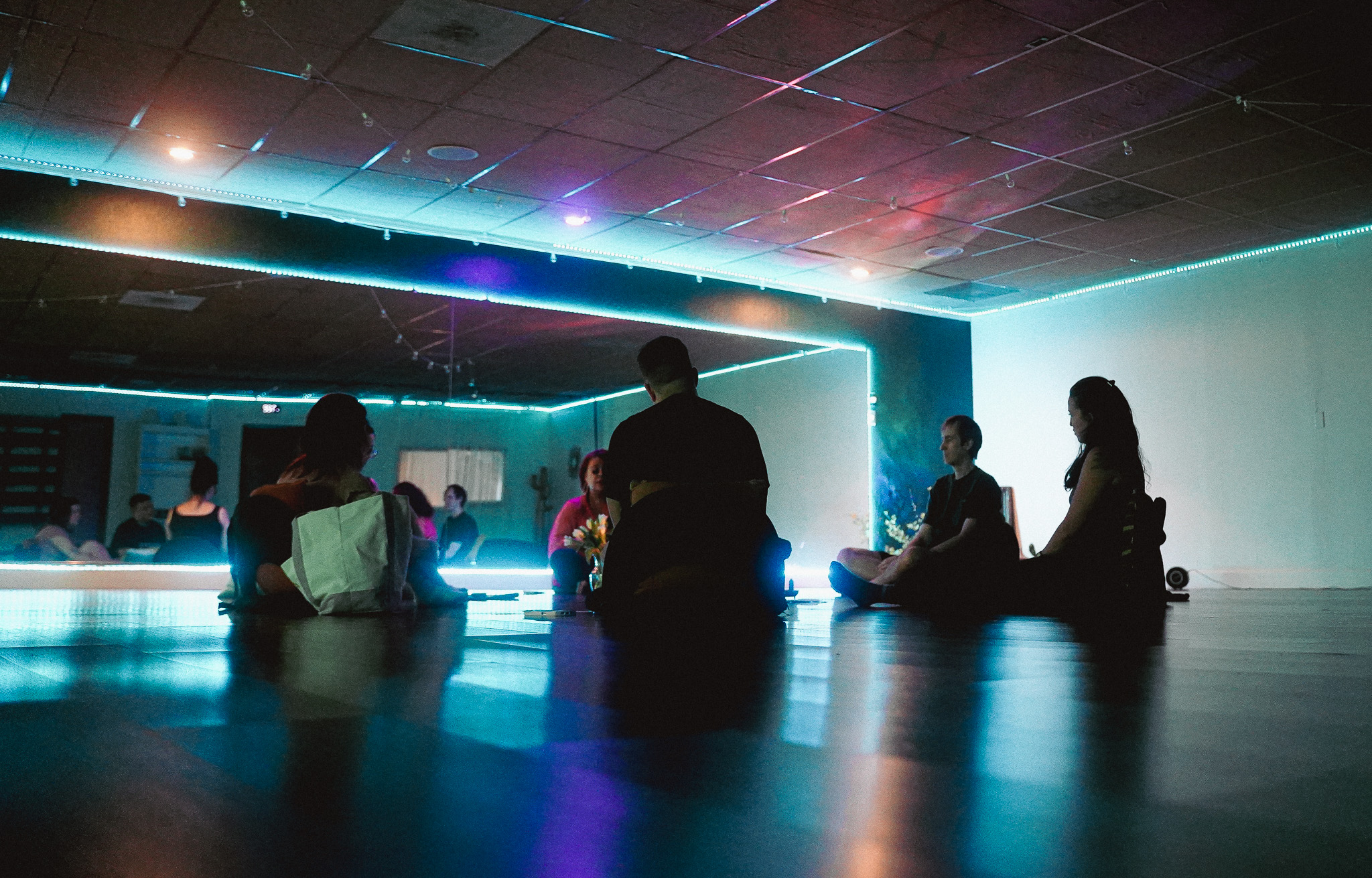
Global Heart Activation at The Healing Tree Collective is an invitation to explore that possibility together. Each gathering centers around a specific theme or human concern and creates space for prayer, meditation, reflection, and collective intention.
We are not asking you to arrive already convinced that consciousness can influence an energetic field. We are not promising that gathering in meditation will cause a measurable change in crime, conflict, or any other external social outcome.
You can come because prayer is meaningful to you. You can come because meditation is meaningful to you. You can come because the idea of shared intention makes you curious. You can come because the world feels overwhelming and you want somewhere to intentionally hold one piece of it with other people.
And perhaps you can come because some part of you still believes that practicing more compassion, more connection, more reflection, and more care is worth doing even before we know exactly how far those things travel.
What would you be willing to help create if you stopped requiring certainty before beginning?
This question reaches far beyond Global Heart Activation. Maybe there is a project, community, relationship, business, creative idea, or different way of living that you keep dismissing because the evidence is not here yet.
That does not mean you should blindly pursue every idea. It means you can examine the difference between an idea that lacks evidence because it is unrealistic and an idea that lacks evidence because nobody has built it yet.
Sometimes the only way to learn which one you are holding is to begin responsibly creating, testing, listening, and allowing reality to answer back.
Maybe some “crazy ideas” deserve a room where they can become real enough to explore
I do not know whether Global Heart Activation will ever create the kind of collective influence imagined by theories like the Maharishi Effect.
I am comfortable saying that.
But I do know that if people gather together, those people are already part of the world they hope to influence.
They are someone’s partner, coworker, parent, friend, neighbor, customer, leader, student, teacher, or stranger they will cross paths with later.
And if we spend time together intentionally practicing compassion, reflection, prayer, meditation, peace, or connection, then there is at least an opportunity for those practices to follow us into those relationships.
Maybe you believe something larger happens too.
I am open to wondering about that.
Because I do not think every unknown possibility needs to be dismissed simply because we cannot yet explain it.
At the same time, I do not think every beautiful possibility should be declared true simply because we want it to be.
There is a space between those extremes.
A place where curiosity, hope, skepticism, spiritual belief, responsibility, and imagination can actually sit together.
That is where I want this conversation to live.
Maybe. Maybe. Maybe.
Maybe collective meditation influences something larger than we currently understand.
Maybe its strongest influence moves through the people who practice it and the relationships they return to afterward.
Maybe both possibilities deserve more exploration.
And maybe none of us needs to have the final answer before deciding that creating a room where people intentionally practice more love, peace, compassion, reflection, and connection is worth trying.
The Healing Tree itself was once an idea.
Somebody had to believe in it before the room filled with people.
Somebody had to act while there were still more questions than answers.
And now we get to stand inside something that once existed only in imagination and ask what else might be possible.
Maybe the purpose of a “delusional” idea is not to convince ourselves it is already real. Maybe it is to give us enough courage to begin creating the conditions where something new could become real.