23 August 2026
The Healing Tree Collective • Self-Inquiry, Identity and Personal Growth
Is This Story Still Serving You? How Old Beliefs Shape the Life You’re Living
Some of the stories you believe about yourself may have been written decades ago. The question is: are you still allowing them to write your life today?
Every one of us carries stories.
Stories about who we are. Stories about what we are capable of. Stories about relationships, work, money, family, love, conflict, success, failure, rest, responsibility, and what we believe is expected of us.
Some of those stories may have been consciously taught to us. Others may have developed so quietly that we cannot remember when we first began believing them.
Maybe the story began five years ago.
Maybe twenty.
Maybe fifty.
But if the belief is still influencing your choices today, then it is worth asking:
Is this story still serving me?
And perhaps an even more important question:
Who else is affected when I continue living by it?

Before reading further, consider one story:
- What do you repeatedly say about yourself?
- How long have you believed it?
- Who taught you that?
- Have you ever actually questioned it?
- What choices does that belief influence today?
- Would you consciously choose that belief now?
How old is the story you are living by?
Think about how different your life may be today compared with twenty or thirty years ago.
Your responsibilities may have changed. Your relationships may have changed. You may have experienced loss, success, failure, parenthood, marriage, divorce, entrepreneurship, leadership, career changes, or seasons that fundamentally reshaped what matters to you.
Yet some of the beliefs guiding your life may have been formed long before any of those experiences happened.
Maybe you learned as a child that conflict should always be avoided.
Maybe you learned that being valuable means being useful.
Perhaps your first experiences with money taught you that there is never enough.
Maybe an early failure became the story that you are “not good at” something.
Or maybe you were praised for being independent, responsible, quiet, strong, or easy to care for… and eventually that description became part of your identity.
But you are not living in the same moment where that story began.
So why should it automatically get to keep making decisions for you?
A belief can be decades old and still influence a decision you make tomorrow.
Try asking the belief for its history.
When did I first begin thinking this way?
What was happening in my life at the time?
Who reinforced this belief?
Did this story once help me make sense of something difficult?
And does my present life still require me to understand myself in the same way?

Old programming can feel like personality
Some beliefs become so familiar that we stop seeing them as beliefs at all.
We begin calling them personality.
“That is just who I am.”
“I have always been that way.”
“I am the person who handles everything.”
“I am terrible at saying no.”
“I do not trust people.”
“I am not creative.”
“I cannot slow down.”
“I have to keep everyone happy.”
But how do we know where personality ends and programming begins?
How much of what we call “who I am” is actually a pattern we practiced for so long that it became automatic?
And what would happen if we treated some of those identities as questions instead of conclusions?
“This is who I have been” does not have to mean “this is who I must remain.”
Turn an identity statement into a question
“I am bad at setting boundaries.”Ask: “When did I learn that setting boundaries was difficult or unsafe?”
“I have to do everything myself.”Ask: “What do I believe would happen if I depended on someone?”
“I am not creative.”Ask: “Who taught me what creativity was supposed to look like?”
“I cannot disappoint people.”Ask: “Why does someone else’s disappointment feel like proof that I did something wrong?”
“I always have to stay busy.”Ask: “What becomes uncomfortable when I stop moving?”
“That is just how my family is.”Ask: “Which parts of this pattern do I actually want to carry forward?”
Your old stories may be helping create your current reality
Our beliefs influence what we notice, what we expect, what we tolerate, how we respond, and which possibilities we consider available to us.
A belief does not magically control everything that happens in our lives. Circumstances, relationships, systems, resources, and events outside our control all matter.
But our internal stories can influence the way we participate within those circumstances.
If you believe asking for help makes you weak, how often will you reach for support?
If you believe conflict always destroys relationships, how many difficult conversations will you avoid?
If you believe success requires constant exhaustion, what kind of work life might you create?
If you believe your needs are less important than everyone else’s, what kinds of relationships might become normal?
If you believe you are “not the kind of person” who can start over, how long might you remain in something you have already outgrown?
The belief does not determine the entire reality, but it can influence the choices through which that reality continues taking shape.
Sometimes the life we keep recreating is connected to a story we have never stopped long enough to question.

Is this story still serving me?
This sounds like a simple question.
It may not be.
Answering it honestly can require us to separate what is familiar from what is actually supportive.
Perhaps a belief helped you survive a difficult period. Maybe it protected you from being disappointed. Perhaps it helped you gain approval, build a career, remain connected to your family, or feel safer during a time when life felt unpredictable.
That history matters.
But appreciation for what a belief once did does not require lifelong loyalty to it.
You can acknowledge, “This helped me once,” and also recognize, “I do not want it directing the next chapter of my life.”
Ask the question more deeply:
Is this story still serving my wellbeing?
Is it helping me create the relationships I want?
Does it support the way I want to parent?
Is it helping me become the leader I want to be?
Does it reflect the values I hold today?
Or am I continuing to live by it mainly because I have carried it for so long?
Your life may be bigger now than when the story began
At some point, many of us realize that our choices no longer affect only us.
Maybe you are a parent now.
Maybe you are a spouse or partner.
Maybe you lead employees, serve clients, mentor younger people, teach students, care for family members, or occupy a position where other people depend on the way you show up.
Suddenly the question “Is this story still serving me?” becomes larger.
Is it serving the people around me?
What happens when an old belief about anger enters my parenting?
What happens when my relationship with overwork becomes part of the culture my team experiences?
What does my partner experience when an old fear of vulnerability keeps me from communicating?
What are my children learning from the way I respond to mistakes?
The stories inside us can become part of the environments around us.
Once other people depend on us, self-awareness is no longer only personal. The way we understand ourselves becomes part of the experience we create for others.
Consider the ripple of one belief
At home
If you believe emotions should be hidden, what might the people closest to you learn about expressing theirs?
At work
If you believe dedication requires constant availability, what expectation might your team begin internalizing?
In relationships
If you believe disagreement means rejection, how might that affect your willingness to communicate honestly?
What are your children learning from the stories you live by?
We often think about what we want to teach children directly.
Be kind.
Believe in yourself.
Take care of your health.
Speak up.
Ask for help.
But children also learn from what they repeatedly witness.
What happens when we tell them that rest matters but never allow ourselves to rest?
What happens when we encourage them to set boundaries but continually ignore our own?
What happens when we tell them mistakes are part of learning but criticize ourselves harshly every time we make one?
What happens when we tell them they can choose their own path while we continue living according to expectations we have never questioned?
None of this requires perfect parenting.
It invites awareness.
The people around us do not learn only from what we tell them. They also learn from what we repeatedly demonstrate.
What is your team learning from the way you lead?
The same question applies to leadership.
A leader may carry a story that says, “A good leader always has the answer.”
How might that belief affect the ability to admit uncertainty or ask the team for input?
A business owner may believe, “If I am not constantly working, everything will fall apart.”
What kind of expectation might that unintentionally create for employees?
Someone may have learned that authority means remaining emotionally distant.
Does that belief help create the kind of workplace culture they actually want?
Leadership gives our internal stories a larger audience.
That does not mean leaders need to resolve every personal pattern before taking responsibility. It means our beliefs deserve examination because other people may experience the consequences of the ones we leave unquestioned.
A question for leaders:
What belief about leadership did you inherit from someone else?
Is that still the kind of leader you want to be?
And if your team began copying the way you currently approach work, stress, communication, and boundaries—would you be comfortable with the culture that created?
Questioning a story does not mean blaming the person who gave it to you
As we become more aware of where our beliefs came from, it can be tempting to search for someone to blame.
Sometimes accountability is appropriate. Real harm should not be minimized.
But not every inherited belief was intentionally handed down.
Parents may teach what they were taught. Leaders may repeat workplace cultures they experienced themselves. Families can carry patterns across generations without anyone stopping long enough to ask where those patterns began.
Recognizing that history does not require us to excuse everything that happened.
It can simply help us understand that we now have an opportunity to decide what continues through us.
You may not have chosen the story you inherited. You can still participate in deciding whether it continues.
What if changing the story feels like betraying where you came from?
Sometimes questioning an inherited belief can create guilt.
If everyone in your family handled life a certain way, choosing differently may feel like rejection.
If sacrifice was deeply valued, prioritizing your own wellbeing may initially feel selfish.
If your community defined success in one particular way, choosing another path may feel like abandoning the expectations placed upon you.
These moments deserve compassion because changing a story can affect our sense of belonging.
But continuing a pattern is not the only way to honor the people who came before us.
What if honoring their effort means taking what they gave you and building something healthier from it?
What if gratitude and change can exist together?
What if you can love your family and still decide that one particular pattern stops with you?
Choosing differently does not always mean rejecting your past. Sometimes it means deciding what you want your past to become through you.

What happens after you realize the story no longer serves you?
Awareness is powerful, but recognizing an old belief does not instantly remove it.
You may fully understand that you no longer want to live by a particular story and still notice yourself returning to it.
That makes sense.
The belief may have been reinforced for decades. It may be connected to routines, relationships, emotional responses, and ways of making decisions that have become automatic.
So the next step becomes practice.
If the old story says, “I have to say yes so people will value me,” perhaps the new practice is tolerating the discomfort of saying no.
If the old story says, “Good parents sacrifice everything,” perhaps the new practice is allowing your children to see you take care of yourself too.
If the old story says, “A strong leader never admits uncertainty,” perhaps the new practice is saying, “I do not know yet. Let’s figure this out together.”
The new story becomes real when it changes the way we participate.
Move from story to practice
I must always be available.New question:
What would healthy availability actually look like?
Saying no makes me selfish.New question:
Can I care about someone and still honor my capacity?
Rest has to be earned.New question:
What if rest is part of caring for my ability to participate?
I have to know exactly what I am doing.New question:
What could I learn by allowing myself to begin imperfectly?
This is simply who I am.New question:
Who might I become if I stopped treating this description as permanent?
Nothing changes in my family.New question:
What is one pattern I can choose not to repeat?
You do not need to replace every old belief today
Once we begin seeing our patterns, it is easy to turn personal growth into another enormous project.
Suddenly we want to change everything.
Every reaction.
Every belief.
Every relationship.
Every part of ourselves.
That can quickly become another form of pressure.
Perhaps the more sustainable practice is choosing one story that has become especially loud and becoming curious about it.
Not attacking it.
Not judging yourself for believing it.
Just asking better questions.
What does this belief do?
Where does it appear?
What happens when I act from it?
What happens when I do something different?
The answers may reveal themselves gradually.
You do not have to rewrite your entire life today. Begin by questioning one sentence you have been repeating for years.
Creating space to question old stories in Tempe, Arizona
At The Healing Tree Collective, we believe slowing down can create an opportunity to hear ourselves more clearly.
Our role is not to tell you which parts of yourself need to change or which beliefs you should replace.
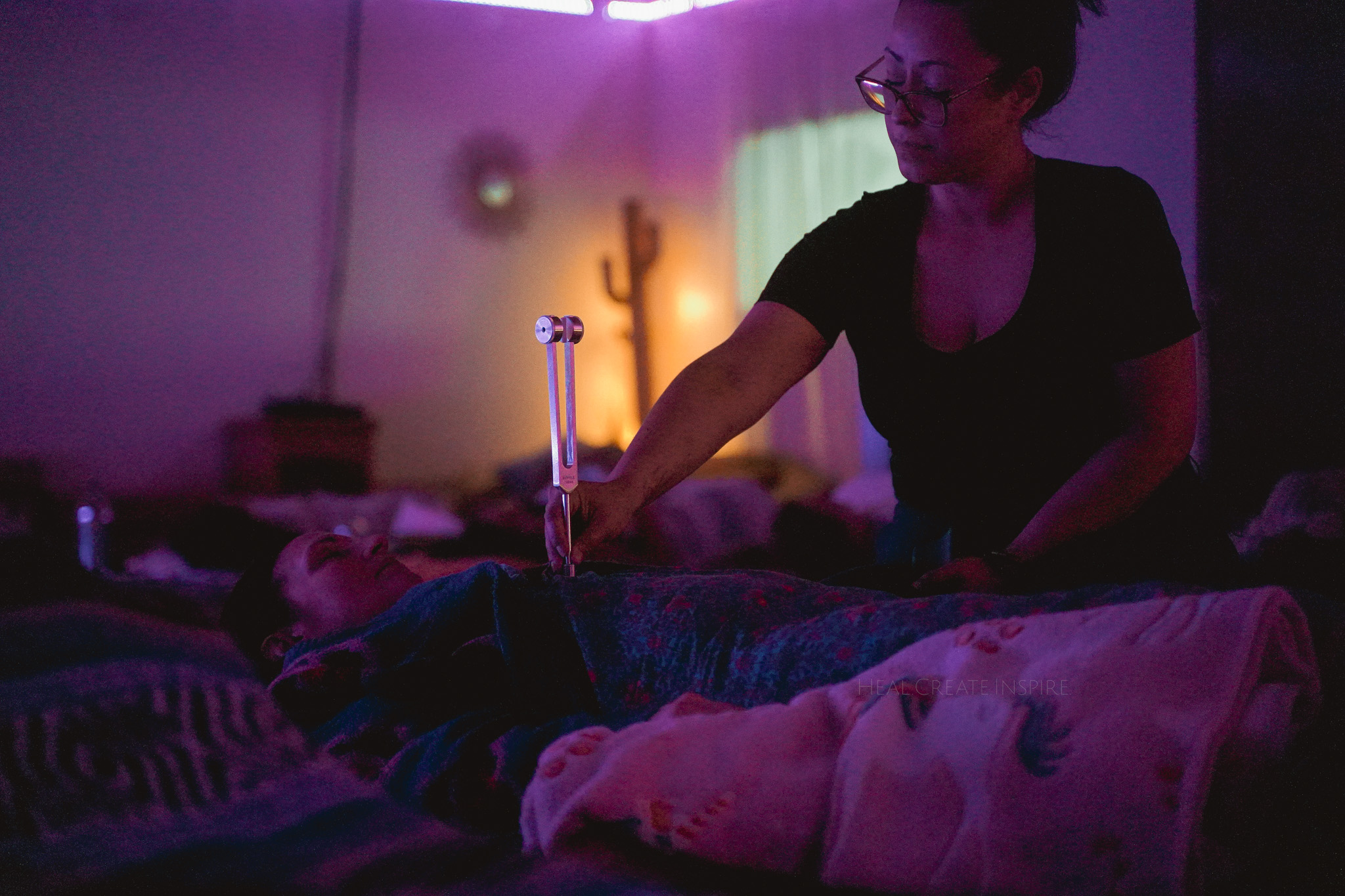
Instead, practices such as breathwork, meditation, sound, Reiki, yoga, Tai Chi, intentional movement, and community reflection can create opportunities to notice what has been operating beneath the surface of everyday life.
Maybe you become aware of a thought you repeat constantly.
Maybe a class gives you enough space to recognize that a familiar response is connected to something much older.
Maybe hearing someone else’s reflection helps you question something you assumed everyone believed.
The practice does not hand you the answer.
It can give you space to begin asking the question.
Explore practices that create room for reflection
Our beginner-friendly community wellness studio in Tempe welcomes guests from Tempe, Phoenix, Mesa, Chandler, Scottsdale, the ASU community, and throughout the East Valley.
You do not need to arrive knowing exactly which story needs your attention. Sometimes the first thing we notice is simply that something in our lives no longer feels the way we want it to.
Doing the work starts with telling yourself the truth
There is a certain kind of honesty required to look at something we have believed for years and admit that it may no longer serve us.
It requires us to stop defending a story simply because it is familiar.
It asks us to look at our choices, relationships, habits, and identities and wonder:
Is this actually what I believe?
Or is this what I learned to believe?
Is this helping me become who I want to become?
Or is it keeping me attached to a version of myself that made sense twenty years ago?
And when the answer is uncomfortable, can we stay curious long enough to hear it?
Because sometimes the story we are most afraid to question is exactly the story shaping the part of our life we most want to change.
One final question:
Think about the part of your life that feels most stuck right now.
Your work. Your relationships. Your boundaries. Your creativity. Your confidence. Your ability to rest.
What story would have to remain true for that situation to remain exactly the same?
And what would become possible if you stopped assuming that story was permanent?
Your work can become someone else’s permission
We do this work first for ourselves.
Because we deserve the opportunity to question what no longer fits, develop a deeper relationship with ourselves, and create lives that reflect the values we hold today.
But our choices do not happen in isolation.
When we question an old family pattern, someone else may realize that they are allowed to question it too.
When we create healthier boundaries, the people around us experience another way of relating.
When we admit that we are learning, our children or employees may feel less pressure to pretend they know everything.
When we allow ourselves to change, we demonstrate that identity does not have to become a prison.
We cannot make another person do their own work.
But sometimes seeing someone else live differently is enough to create a question.
And questions can create openings.
Is this story still serving you?
Not the version of you from twenty years ago. Not the expectations someone else placed on you. Not the identity you learned to protect.
You.. as you are today.
Does the story support your relationships? Your family? Your work? Your wellbeing? The person you are becoming? The environments you are helping create for the people around you?
At The Healing Tree Collective, we create opportunities to slow down, listen inward, and explore the stories beneath the way we live. We are not here to tell you what your new story should be. The invitation is to become curious enough to recognize when an old one may no longer belong.